Camila can't go back in time but you can benefit from her advice now
Camila Modena
Freelance Developer
I’m Camila, a 25-year-old Brazilian who grew up in the southern English town of Bournemouth. I got my first job at 15 when I started working in a fish and chip shop, partly because I could earn a few quid but mostly because I was allowed to take home all the unsold chips. At the end of my first shift, I took a picture of myself in my oil-stained apron proudly holding up the first £1 I’d ever earned, before putting it on Facebook so everyone could see that I was now an independent woman who paid her own way in the world while earning £5 an hour. From that day, hospitality would become all I would know for 10 years.
Over the years, I gradually made the move away from passing food over a counter and ended up working in specialty coffee as a barista and a supervisor, a job I loved hugely which taught me my first real sense of responsibility. However there was something missing; I’d always wanted to see more of the world, and living the way I was meant I was forever having to come back home to re-make the money I’d spent on my trips. I was sick of seeing the runway at Heathrow Airport coming towards me so often, so I decided I wanted to find a way to work while I traveled. Fuelled by minimal research and maximum frustration, I ended up applying for Le Wagon.
But making a change like this didn’t come without the need for adaptation, and brushing the cobwebs off my largely-neglected cerebrum was only the tip of the iceberg. Not only was a day spent sitting in front of a screen largely new to me, but I also felt that anything I struggled with must’ve been because I was one of the only students in the batch that didn’t come from an office-based background. Subsequently, I resolved that I was at least 5 years behind everyone else and I should publicly proclaim my idiocy and allow myself to be pelted with tomatoes until I learned never to attempt a career change again.
[Cue record scratch sound effect]
That was me 6 months ago. Now, I’m a freelance developer and a TA at Le Wagon, having gone from not being able to cite a single substantial reason for wanting to do the bootcamp in my interview to eventually fully falling in love with coding and all its possibilities. Looking back on the challenges I faced at the beginning, I feel that if I’d had the perspective I have now, it would’ve meant that perhaps I wouldn’t have felt the need to use up my entire lunch hour sprinting up and down the street just to run the anxiety out. I can’t go back and tell myself what I know now, but I can tell you, current or future bootcamper! So here it goes:
1. The challenges aren’t supposed to be easy
This seems obvious to me now; going from printing ‘hello world!’ to building a fully functioning web app in only 9 weeks is a huge feat, so your learning has to progress quickly. Not only that, but the world of coding is infinite, and there’s no more a chance that as a developer you’ll know the solution to everything than there is that you’ll develop the ability to cry tears of fresh lemonade. A huge part of being a developer is knowing how to Google the right questions, use online resources well, and work things out as a team.
I didn’t realize this at all at the time and found myself feeling like I had the IQ of a potato when I wasn’t able to immediately do all of the challenges from start to finish with no help. My confidence took many hits and I often felt like I was incompetent and falling behind. Contrary to reality, I assumed everyone else on the bootcamp was acing each challenge without help, which brings me to my next point…
2. Befriend your fellow bootcampers
This one may come naturally to everyone who decides to do the bootcamp in person, but it can be a little harder for those like myself who were - for the most part, anyway - joining remotely. I don’t consider myself to be someone who struggles to talk to people they don’t know - on the contrary, it was one of my favorite things when I used to serve customers - but these weren’t the face-to-face interactions I was accustomed to, and I was bewildered by having to collaborate with people who were just 2D entities on my screen. I became the ominous person who would keep their camera and sound off until directly addressed, and the lack of chats with my peers was exactly what lead me to assume that they were progressing miles ahead of me each day.
This only changed in week 7 when we were put into teams for our AirBnB clones and final project, and being put in a position where I had no choice but to set my Zoom phobia aside made me realize that it only took about half a conversation for me to feel at ease with someone. Not long after the start of AirBnB week, my team and I ended up staying on a call together after hours drinking beer and talking about life and to say that exponentially changed the scope of the final three weeks would be an understatement. I realized that I could genuinely bond with someone without meeting them in person, and my eyes were opened to the fact that their experiences during the bootcamp had been very similar to mine; they too had suffered imposter syndrome, existential dread, the feeling of floating in an empty void of confusion, and so on.
Having this bond with my teammates made our time working together not only a lot of fun, but I believe it also contributed to the success of our projects. It became more important than ever before to be comfortable asking each other for help, giving honest feedback, and supporting each other during stressful times.
3. To avoid getting overwhelmed, take the time to reverse-engineer your code line by line
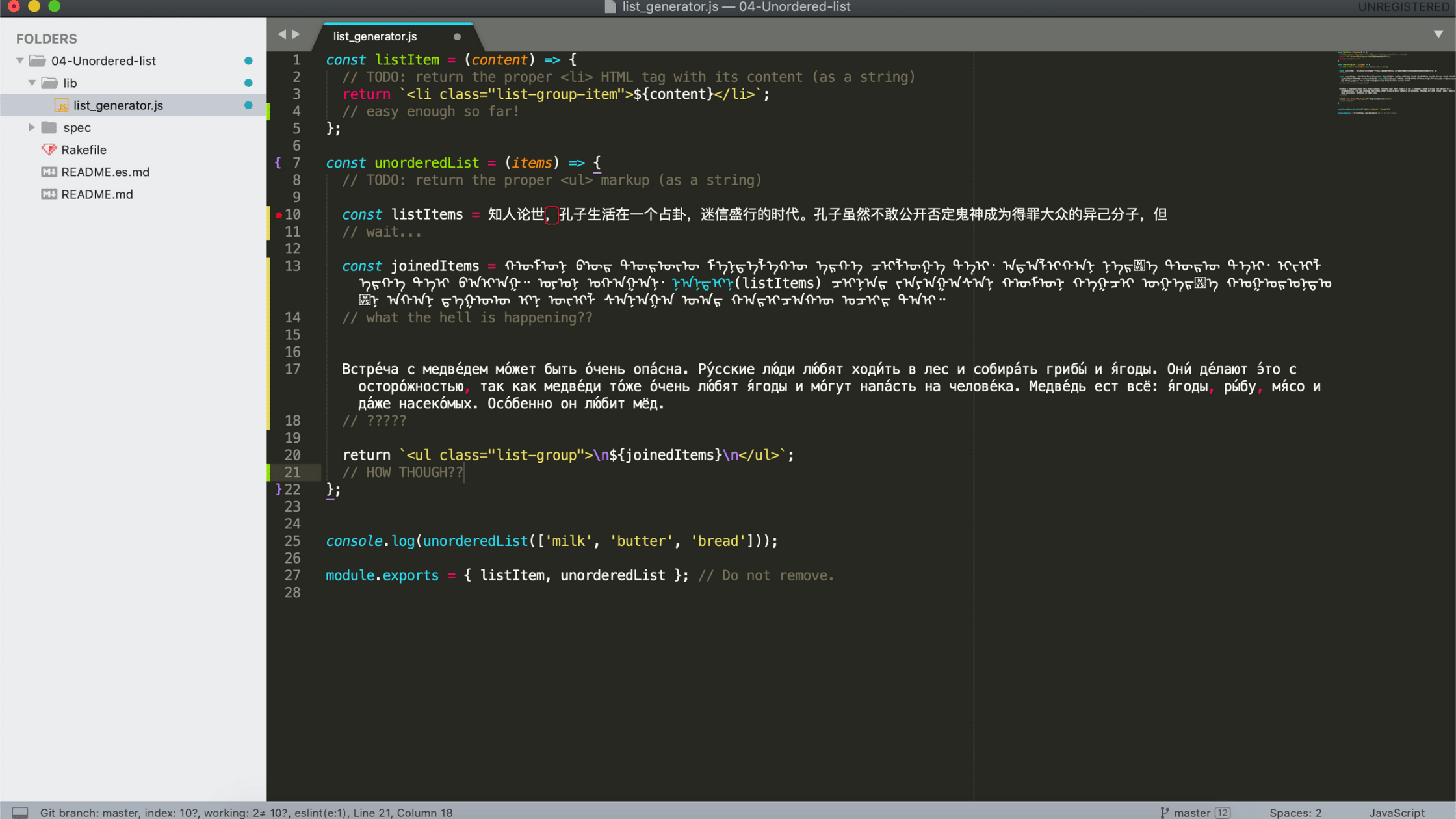
This was something I only started doing during week 5 when I inched dangerously close to a total brain implosion. I was no stranger to having a TA come to my virtual table by request of another student, talk us through the exercise from start to finish before asking if we all understood what we had just done, only for me to proclaim in unison with everyone else: “Yeah, makes perfect sense!” despite having just watched the lovechild of hieroglyphics and Mongolian scripture appear before my very eyes. But week 5 was JavaScript week, and my cognition that had only just started warming to Ruby was about to experience a complete 404 from looking at a wall of text that in some unfathomable way was making a drop-down menu appear.
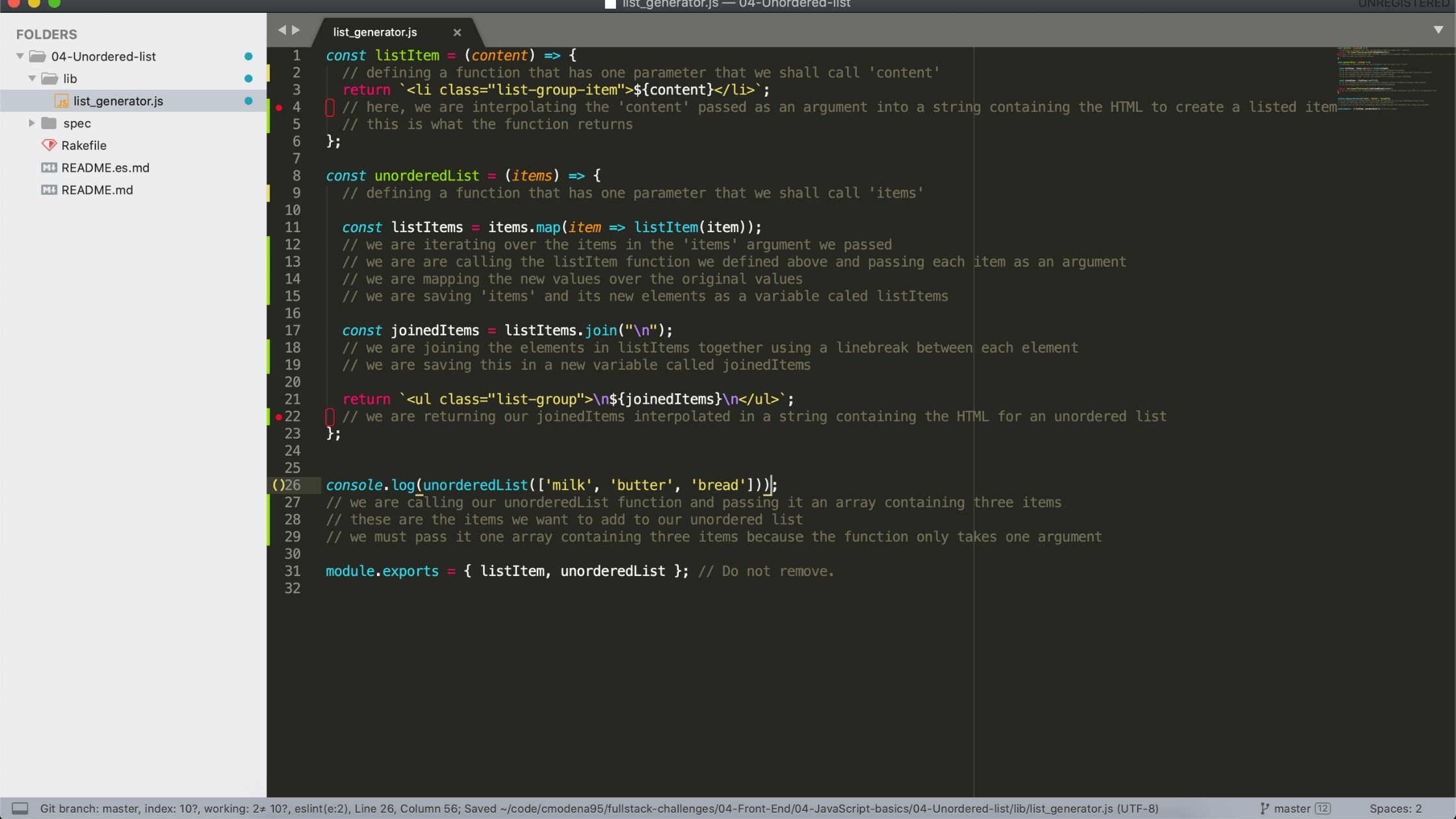
But just seconds before my will to ever touch a computer again packed its bags and walked out the door, something in me took a U-turn and I decided to take it from the top, line by line, character by character. I wrote down exactly what was happening on each line and at each stage, using human sentences written in English. To my amazement, upon reaching the last line and looking at what was previously just a keyboard-bashed gibberish mess, I was now able to make sense of everything that was happening at each stage and why. Before reverse engineering your code…And - thankfully - after!
It has to be said that Le Wagon teachers and TAs have the patience of the Buddha himself and will happily explain things as many times and in as many different ways as needed. But as a student, there may be times where you’ll panic yourself into a mental state that has somewhat similar properties to a scrambled egg, and as a result, you’ll struggle to absorb things. Taking the time to reverse-engineer the code, practically to the point of a very detailed pseudo-code, helped me break things down so I could understand all of the functions and concepts within it rather than only what the code as a whole was achieving. It was also helpful as a knowledge-testing activity on the challenges that I felt comfortable with, and then once again when I revisited them as a fresh bootcamp graduate because it helped me remember the logic involved in the exercise.
During the first week of the bootcamp, you’ll feel like you’re about to be in for the longest journey of your life. Then you go to get a coffee, stretch your legs a little, and you come back to your desk to find that somehow 9 weeks have passed and it’s now demo day; you’re now stood in front of a crowd, pitching the web app you’ve worked so hard on over the last two weeks. Your teammates are fighting back the tears and the city manager is polishing the gold key to your new Silicon Valley office.
The ride’s over before you know it, and I’m not going to sugarcoat things and tell you it’s always going to be easy; but I can tell you what I learned through experience in the hopes that you don’t have to, so you can spend more time focusing on laying the foundations for your future in what very well may be the first step of a terrifying, but infinitely limitless, exciting new journey...
From mechanical engineering studies to data science: the journey of Brieuc
Brieuc Boonen
Data Scientist
Agilytic
My name is Brieuc Boonen. I studied mechanical engineering at UCL, in Belgium. After submitting my thesis, in which I had to process a tremendous amount of data, I realised that I had very little experience in this field (Matlab was cool, but Python looked even cooler 😎). This made me want to learn more about this topic and attending a Data Science bootcamp seemed to be a great opportunity to deepen my knowledge.
What did you like about the bootcamp?
It was a great experience! Even with a technical academic background, I learned new concepts that I was not familiar with.
The greatest added value of Le Wagon is the presence of competent teachers, available at all times to answer questions, and to bring their expertise to best tackle "code challenges".
I really enjoyed the roadmap, which aims to discover all the principles that drive data science.
What is your role now?
Since finishing the Data Science Bootcamp at Le Wagon in 2020, I've been working as a Data Scientist at Agilytic. We are a growing consultancy firm helping companies across many industries (such as banking, insurance, telecommunications, healthcare, pharmaceuticals, automotive, and more) to achieve their goals through the smarter use of data.
I really like my experience in this role. Since day one, I have acquired a certain level of responsibility and ownership. In fact, I am responsible for every project I’m part of, from data analytics and modeling to data storytelling and providing recommendations. If I need help, a Senior Data Scientist is always there to offer guidance. In my spare time, I also can study various certifications to continue expanding my knowledge and improve my skills.
So far, I have already established a segmentation, a dispatching algorithm, developed a web app interface using Flask and passed my first certification: Power BI. Next up between two projects, I look forward to acquiring both DataBricks and AWS Cloud Practioner certifications.
If you're interested in data science or data engineering, Agilytic is hiring! Check out www.agilytic.be/careers
How did your job search go after graduating from Le Wagon?
The IA/Data Science field is still relatively new in Belgium, in particular in Brussels. I discovered this opportunity, mainly through word of mouth, but also via social networks, thanks to the BestRegards podcasts (co-created by our Data Science alumni, Joanna Vitiello). I had four interviews, one of which was purely technical. Fortunately, Le Wagon gave me confidence in my Python programming skills to succeed.
A piece of advice for people looking to start their journey in Data Science?
1. Take the time to learn all the mathematical and programming concepts behind it. Once you have the fundamentals down, it is much easier to add an extra layer of knowledge.
2.Data science allows you to exploit data from top to bottom. You can easily get lost. It's your job to stay focused on the objectives and build a story around the data. In fact, this is almost the most difficult thing in the field 😉
Meet Ilse: from hungry for a challenge to now a Jr Front-end Developer
Ilse Rodriguez
Front-end Developer
Holded
Hi Ilse, please introduce yourself!
I’m Ilse and I am from México! I left my country in 2012 and since then I’ve lived in Spain and the Netherlands.
What was your experience before the bootcamp?
My academic background is in Audiovisual Production, but I’ve always been curious about maths and science (I have a technical degree in Programming, Physics, and Mathematics). When I started my work life I did a bit of everything, from working for a bit in the film industry in Mexico to being a translator & proofreader for Booking.com and then taking a job as an HR Generalist + Bookkeeper where I developed Management experience. I’ve always been curious about the world, meeting people, and gathering experiences!
How did you decide to learn how to code?
Like many of us, the pandemic made me question where I wanted to go in life, how I wanted to further my career and sort of gather my vast (and collage-like) work experience. The pandemic made me realize how things can change in a second and how to enter “resourceful mode” in a heartbeat. I didn’t know exactly what I wanted to do but I was very hungry for a challenge and I was yearning to put my brains to the test. The isolation and uncertainty brought by the times were the ultimate reset button. So I decided I wanted to build from it, and learning how to code was a shiny beam of hope that seemed to gather everything I love: creativity, challenge/perseverance, and being a part of a collaborative community.
Why did you choose Le Wagon?
I wanted to immerse myself in the subject, so I read what could be achieved by completing a coding bootcamp. I narrowed the options down and talked with some of the people in charge, but the first interview I had at Le Wagon with Gus was the deciding factor. It was such a candid talk where I could ask questions and that’s where the journey began.
What are you up to now? Tell us more!
I finished my batch in December 2020 and since then, I started working on web development/SEO projects. I recently got a job as a Jr Frontend Developer at Holded. I am very grateful to have the chance to work in a company where every day brings a lot of learning and I’m surrounded by a team of very smart people that are always happy to share knowledge and are very supportive of Jr profiles like mine!
Any advice to find the right company/job after?
I can only talk from personal experience, but use your resources: projects you can get involved with, coding challenges, job interviews, job applications, etc. It can all act as a resource to dip your feet in the water, find what you want to do and where you want to go. The path is not defined for anyone, but we all get to experience things that might point us in the right direction! Don’t be shy to mention you are looking for a job or to put yourself out there for working on projects you are interested in.
How does what you learned help in your current role?
I think we can all acquire technical knowledge with practice and research, but working with a team of developers is a great thing to learn as well! How to distribute and prioritize tasks and not being shy to ask around when you are feeling lost. Learning to discuss and justify your code is very important too!
What did you like most about your experience with Le Wagon?
The moments I got to spend with my classmates and teachers, talking about how intense/fast days were going by, laughing about it, and sharing the experience with like-minded people that became great friends. Also, the materialization of our final (and ongoing!) project, Amandla.
Who would you recommend the bootcamp to?
I would recommend it to anyone curious about technology, and that is a broad spectrum, I know. But coding is a skill that can be an incredibly powerful tool and if you feel like you can benefit in any way from it, don’t hesitate to join Le Wagon!
What advice would you give to those currently doing the bootcamp?
Never stop coding!
Thank you, Ilse! Any closing words?
I just want to thank everyone that has brought knowledge, patience, and kindness to my life from the moment I decided to learn how to code! Acquiring a new skill is great and a lot of times a challenging feeling and I want to encourage anyone that reads this, at any stage they are in their lives, to do so. From learning to code a powerful algorithm to finally baking the best cake, never stop learning.
Hello, Aishu! How did your interest in Data Science evolve?
After finishing my undergraduate degree in electronics engineering, I realised I loved research and wanted to push it further. I started my career in academia, with a focus on satellite and wireless communications since I truly loved working with antennas and tracking satellites. At the same time, a friend introduced me to programming and I became fascinated by what a few lines could do.
When my family moved to Japan, I landed an internship at a software company and learned Python. This ended up being a great stepping stone for a career in data science. I realized that I really enjoyed going from messy data to clean insights and finding patterns to make better decisions.
Long story short, I attended a Le Wagon workshop for data analytics and really enjoyed Trouni’s (one of our Lead Teachers) teaching style. When I learned that a full Data Science bootcamp would be taught the next semester, I immediately decided to apply.
What did you like about the bootcamp?
The whole curriculum was challenging and well-organized. Learning all of that stuff laid a solid groundwork not only for my graduation project but also for all my personal projects afterwards.
I particularly loved the data analytics module. Never having learned statistics before and discovering some patterns in data was a blast.
It was sometimes challenging for me to understand the theoretical part of some machine learning models like linear regression, but Le Wagon teachers managed to break down the subject in a very nice and clear way. The greatest thing about the bootcamp is that even the most difficult technical knowledge can be taught to people coming from non-math backgrounds like me.
What did you do for your final project?
Together with my teammates Arron and Njeri, we worked on an application that could split any song into different musical instruments. At first, we researched models that could be a good case for separating tracks, and after that we split up roles to speed up the development process. I was working on the front end (using Streamlit) and some back-end on limited parts. I am quite proud of our pitch during Demo Day, and I am pretty sure it caught some people’s attention!
What did you do after graduation?
After the bootcamp, I started working on a personal project with a goal to predict poverty. I was inspired by a few Stanford students who wanted to use satellite images to map poor regions. It helped me realize that my passion lies in working with meaningful projects and I started to apply for jobs with that in mind.
Eventually, I received two job offers and accepted a junior data scientist position from Virtusize, my current employer. As a shopaholic, I am very familiar with the frustration of buying clothes that do not fit and having to return them. Virtusize solves this problem by developing a virtual fitting solution that enables online fashion retailers to illustrate size and fit for consumers. I am very excited about the product and will work doubly hard to help Virtusize become the standard solution for size and fit in the Asian online fashion industry and beyond.
Over 50% of our company are women. Let me tell you more: the whole data science team are women! I’m proud to work in a supportive environment where everyone is encouraged to pursue their passions regardless of gender and background.
Sounds amazing! Thanks for the talk, Aishu. Wishing you all the best in your career journey.
Mariam: Transition from A Teacher to A Data Analyst
Mariam Ammar
Data Analyst
31TEN
What were you doing before you join Le Wagon? What makes you switch to a data career?
Consider What You Want
I have my bachelor's degree in Art and master's in Economics. When I first came to Shanghai, I was working at a bilingual school and tutoring on the side. Working in Education in China has a lot of benefits, but I found that I was no longer feeling challenged after all the excitement that came from traveling and taking holidays wore off.
After a while, I would start to ask myself what I really wanted to do long-term. "Do I want to become a teacher? If i want to be a teacher, then need to take it more seriously and become certificated". I realized that I wanted to pursue a different path and I started to search for economics related positions. To be honest, I had little idea of what I really wanted to do and "data science" appeared many times in my searches. I started to learn about this new field and decided that this was the one I wanted to commit to. Mariam
Why chose Le Wagon?
Coding Workout with Classmates at Le Wagon
I believe different people join for different reasons. Some people join because they want to work better with their data team at their own company. I participated in the bootcamp as a step to build my career in data science.
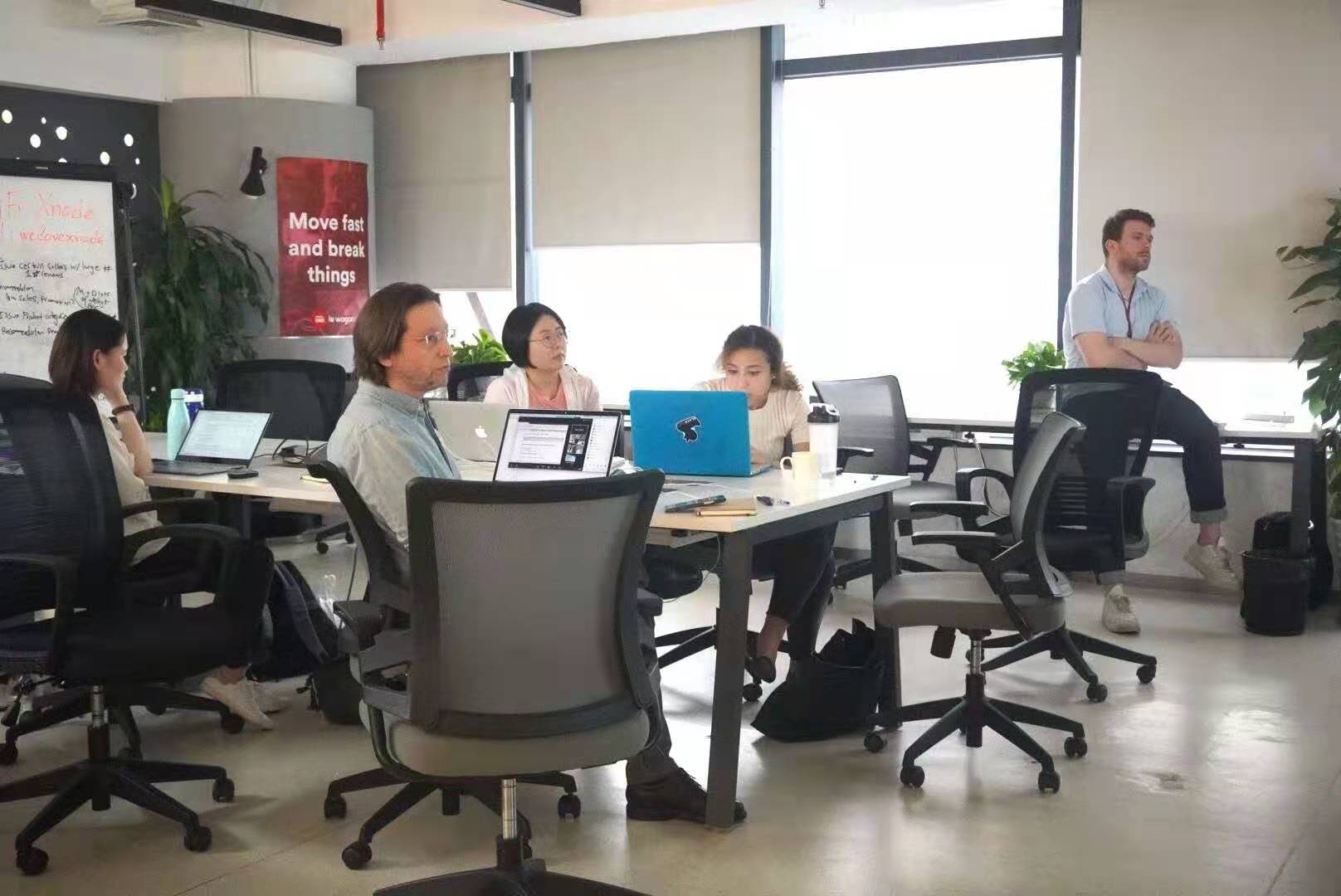
Data Science Bootcamp in Shanghai provides a good community learning after COVID Hits. After COVID, many US university courses took place online however here in Shanghai Le Wagon was able to hold onsite classes. Like working out, you are going to exert yourself a lot more when you are doing it with a group of people onsite than you would if you were alone. Also you get the support and help from instructors and classmates. Marriam's Data Science classroom at Le Wagon, with instructor Pavel and classmatesHow was the experience at Le Wagon? Was the bootcamp intense and difficult for you?
Have A Growth Mindset
It depends on how difficult and intense you want to make it. I was honest to myself and knew my weaknesses and strengths. Coming from a non-technical background, nobody can be a data scientist in just two months. Instead of aiming to grasp every detail of the courses, I made sure I understood the fundamental concepts so that I could revisit the content that interested me and dive deeper later on.
Having a growth mindset is very important. Everybody in the classroom came from a varied level of the tech background. It is hard to do sometimes, but you should always focus on how you improve personally instead of comparing yourself with others. Coding and math may seem intimidating at first but with enough time and effort anyone can become a key player. The program also gives a good overview of data science, a quite complex and dynamic field.Mariam at Le Wagon
What position are you doing right now?
I work as data analysis manager for digital agency 31Ten . My job focuses on developing our data departments and providing data science solutions for our clients to grow their business successfully.
Foreign companies are mesmerized by the diverse digital ecosystem that China has to offer. They are interested in creating WeChat Mini Programs and came to us to help them get on the local platform to enter the chinese market. We also do social media marketing for them. The chinese market is quite competitive. You have a lot of talent working around the clock and adapting quickly to the changed. In tech, and particularly here in China, you need to always be learning. Most of the foreign companies have to change their entire strategy to set up.
How did you find the job, was it smooth to get into the China tech world as a foreigner?
Le Wagon's Connection Is Powerful
It is hard even if you are a local. It's about putting effort in including going to network events, making yourself visible in groups, communities. Le Wagon provides me with very good connections. When I went to interviews, most of the interviewers knew about what Le Wagon was or had a direct connection with one of the instructors. Le Wagon certainly has a name in the tech industry here in Shanghai. ClassHow was your transition to the data world? Was it a big step?
Nothing That Is Worth Doing Comes Easy
Of course. Now, I hold a lot more responsibility than the teaching job because most of our clients are big international companies from different industries. My first major project was creating data literacy course for a major fashion luxury brand. There was a very steep learning curve. However, it is rewarding because I learned a lot, not only about data but also about other fields and industries.
Nothing that is worth doing is easy. You have to be proactive, put yourself out there, be okay about struggling and working hard. It is also about managing your expectations because it is simply not possible to become a developer or data scientist in a couple of months. To make full use of Le Wagon, you need to see it as a starting point that can propel you towards your new journey.
Want to know more about the Data Science Bootcamp?
Now we have both full-time and part-time options here in Shanghai
Click the link below to download the syllabus or directly sign up for the course.
10% early bird discount available until April 2nd, 2021!